
Buying a home in Utah, made clear.
One place for the whole journey — readiness, affordability, loan programs, pre-approval, offers, inspection, appraisal, underwriting, and closing. Free worksheets and calculators at every step.
Buying a home in Utah follows a predictable order: check your readiness, prepare credit and cash, get pre-approved, shop within a written budget, make an offer, complete the inspection and appraisal, clear underwriting, and close. Most Utah purchases close in roughly 18 to 30 days from an accepted offer. Start with the Mortgage Readiness Quiz to see where you stand, then use the Utah Home Buyer Decision Worksheet to set your budget and priorities before you shop.
Step one of the Utah buying process is qualification, not house shopping. Confirm credit, debt-to-income, and documented funds first. Credit and Mortgage Readiness →
Start here
Three resources, three different jobs. Use them in this order.
A five-minute self-assessment that shows how prepared you are and which resource to use next.
Set your priorities, timeline, budget range, features, and loan program preferences before you shop.
The visual overview of the journey — from meeting a mortgage professional through closing.

The Utah First-Time Homebuyer Consumer Guide
The complete educational guide to buying in Utah: financial preparation, the buying process, loan programs, down payment, closing costs, underwriting, appraisal, inspections, common mistakes, FAQs, a glossary, a preparation worksheet, and trusted resources — in one document.
The Utah home buying process, start to finish
1. Should you buy now?
Compare renting and buying against your timeline, job stability, and how long you expect to stay. There is no universally right answer — the Mortgage Readiness Quiz and the Buyer Decision Worksheet help you decide with written numbers instead of a feeling.
2. Financial preparation
Build a picture of income, existing debt payments, savings, and reserves. Avoid new credit accounts, financed vehicles, and large unexplained deposits while you prepare.
3. Credit readiness
Lenders generally use the middle of three scores. Credit changes typically take 30 to 45 days to report, so start early. Minimum scores vary by program, lender, and individual circumstances.
4. Home affordability
Affordability is driven by income, debts, credit, program, rate, taxes, insurance, and how much payment you are comfortable with. Run the affordability calculator, then confirm with a licensed loan officer.
5. Down payment
Twenty percent is not required for most Utah buyers. Conventional, FHA, VA, and USDA options each carry different down payment rules, and down payment assistance may be available for eligible buyers.
6. Closing costs
Closing costs and prepaid items are separate from the down payment. Seller-paid closing costs, lender credits, and gift funds can reduce the cash you bring, subject to program limits.
7. Loan programs
FHA, VA, USDA, and conventional financing each fit different borrowers. Program fit depends on credit, cash, property type, location, service history, and long-term plans.
8. Pre-approval
A real pre-approval reviews credit, income, and assets. It tells you your working price range and is what Utah sellers expect to see attached to an offer.
9. Shopping for a home
Work from the priorities you wrote down: location, size, condition, commute, schools, and the features you are willing to trade. A written list keeps tours from turning into impulse decisions.
10. Making an offer
Price is only one term. Earnest money, deadlines, contingencies, seller concessions, and possession all shape whether an offer is accepted and whether it protects you.
11. Inspection
Inspections are typically completed in the first one to two weeks after acceptance. You then decide whether to accept the condition, request repairs or a credit, or cancel within your contractual deadlines.
12. Appraisal
The lender orders an appraisal to support value. If the appraised value comes in below the contract price, the parties renegotiate, the buyer covers the difference, or the contract terms control what happens next.
13. Underwriting
Underwriting verifies income, assets, credit, the property, and the file as a whole. Respond to document requests quickly, and do not change jobs, open credit, or move money during this period.
14. Closing
You review final numbers, sign at a title or settlement office, fund, and record. Most Utah purchases close in roughly 18 to 30 days from accepted offer.
15. Becoming a homeowner
After closing come property taxes, homeowners insurance renewals, maintenance, and equity strategy. The first-year homeowner and maintenance guides pick up where the purchase ends.
Buying worksheets and checklists
Free, printable, and educational. Each one has a distinct job.
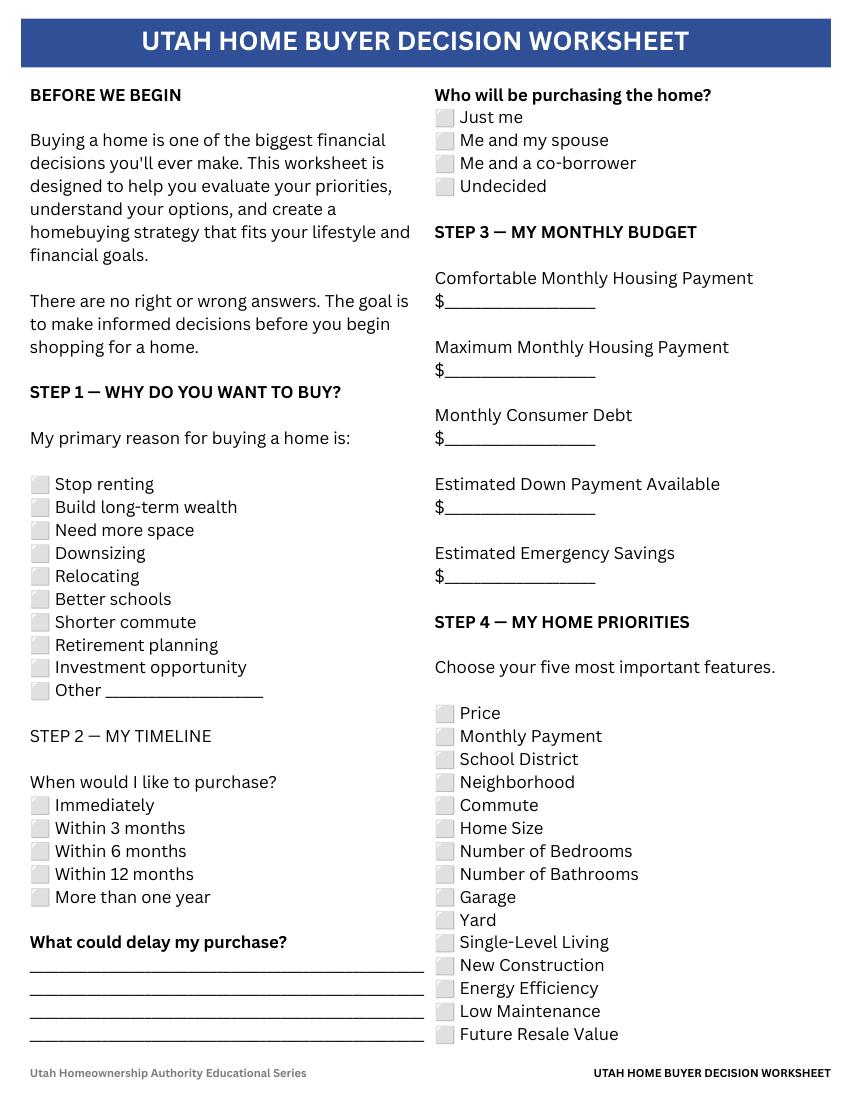
Utah Home Buyer Decision Worksheet
Evaluate your priorities, compare your options, and build a home-buying strategy before you start shopping.
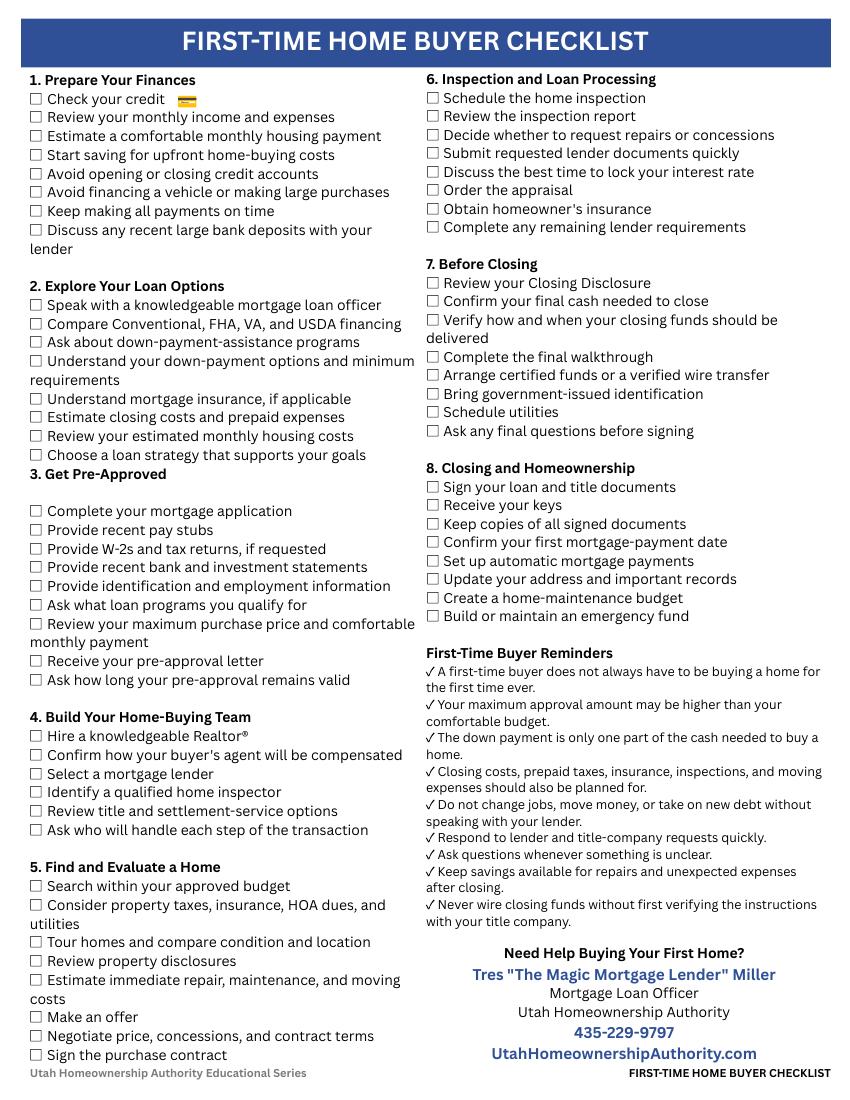
Utah First-Time Home Buyer Checklist
Every task from financial preparation through closing and your first months of homeownership.
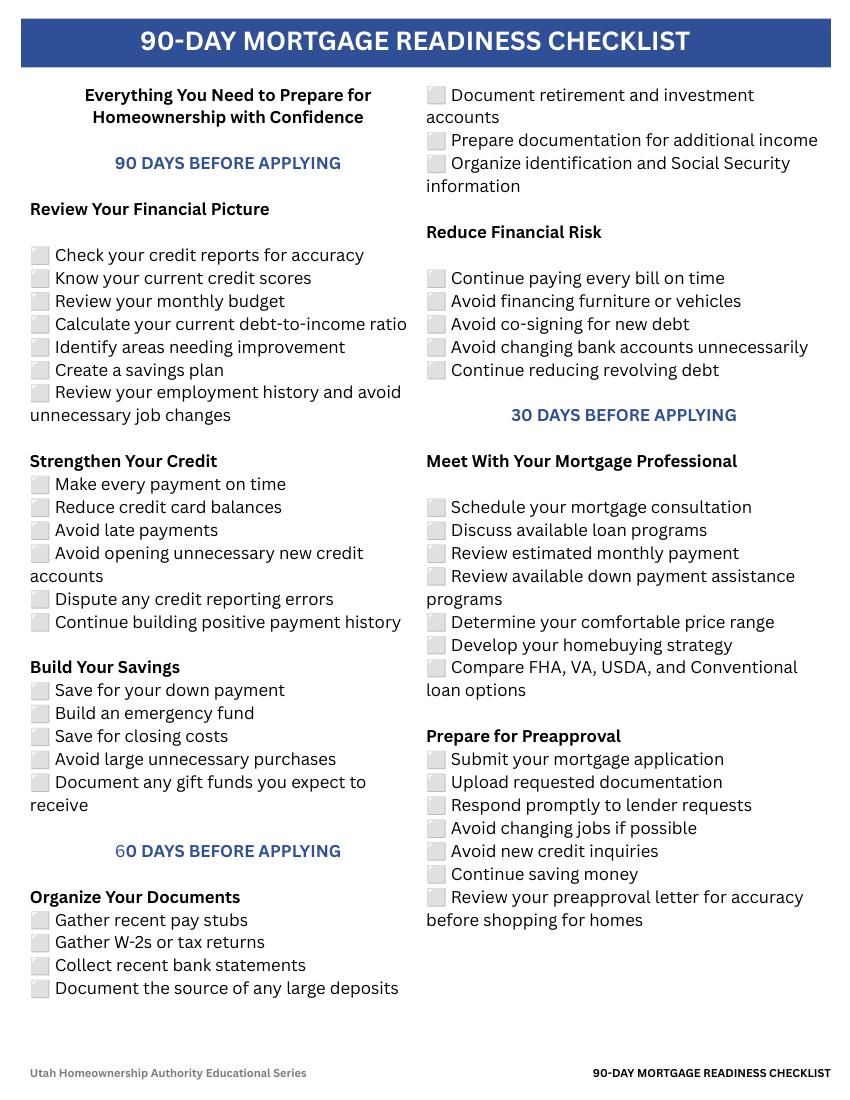
The 90-Day Utah Mortgage Readiness Checklist
A month-by-month plan to get credit, cash, and documents mortgage-ready before you write an offer in Utah.
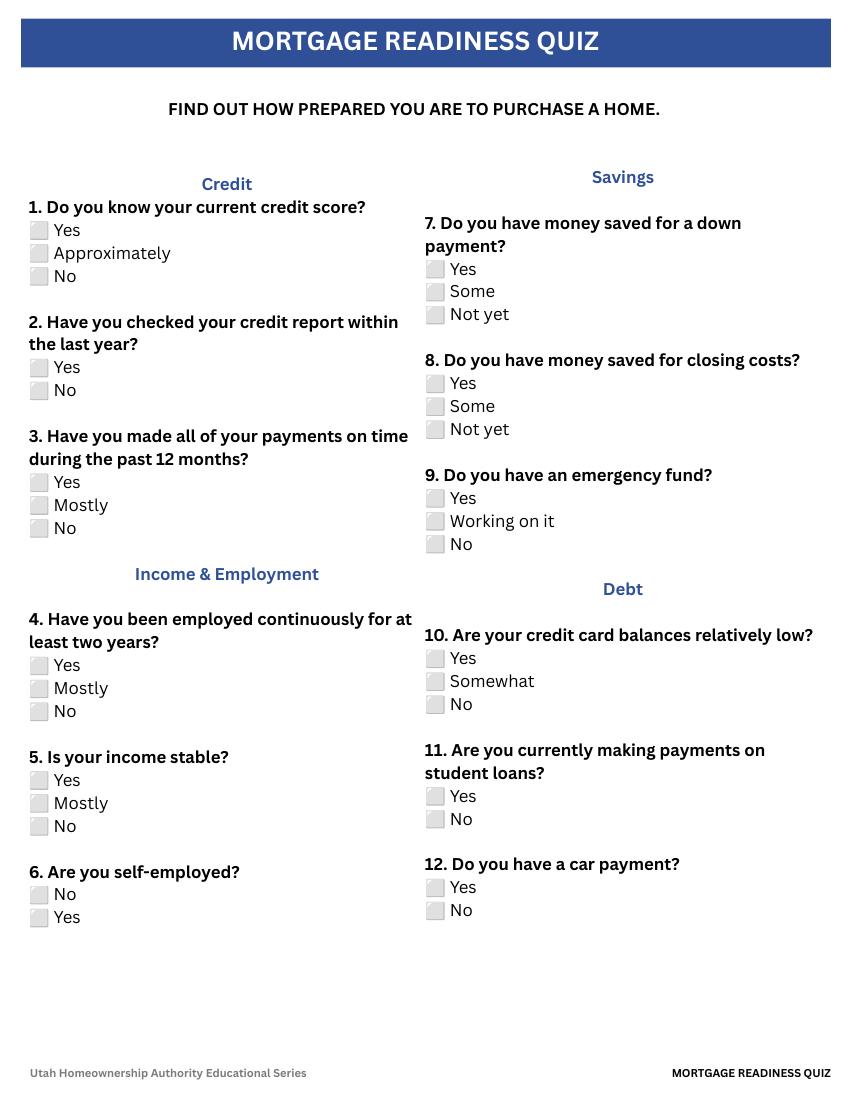
Mortgage Readiness Quiz
A short self-assessment that shows how prepared you are to buy — and what to do next.
Utah Home Affordability Worksheet
Map your income, debts, and reserves to a comfortable Utah home price.

The Utah First-Time Buyer Savings Planner
Turn a down payment goal into a monthly savings number you can actually hit.
The visual overview of the buying journey and an entry point into the Starter Kit Library — the companion piece to the Buyer Decision Worksheet.
Run your numbers
Loan programs and supporting guides
Flexible credit and low down payment options.
Zero-down financing for eligible veterans and service members.
Zero-down financing in eligible rural Utah areas.
The most common financing path in Utah.
Grants, forgivable loans, and eligibility across Utah.
Build stronger credit before you apply.
Every term you will see on a loan estimate.
What you pay at closing and who pays it.
Coverage, cost, and escrow for Utah homeowners.
How Utah property taxes are assessed and escrowed.
Buying videos by topic
Every video below is in the Video Library with a thumbnail, description, and captions available on YouTube.
Preparing to Buy

Factors homebuyers may consider when deciding whether to purchase a home now or wait — personal finances, housing needs, market conditions, and long-term goals.

The truth about down payments in Utah today.

How Utah buyers who assume they can't afford a home often qualify with the right loan program, down payment assistance, or credit strategy.
Mortgage Readiness

Five common mistakes homebuyers make during the mortgage and home-buying process, and how better preparation helps buyers make more informed decisions.

Tres Miller busts three of the most common mortgage myths Utah homebuyers still believe — and shows what the truth means for your down payment, credit, and offer.

The same mistakes buyers keep making — and easy fixes.
Affordability

The key factors that influence home affordability — income, debts, available cash, and the monthly payment a buyer is comfortable managing.

The types of cash a homebuyer may need when purchasing a home — down payment, closing costs, prepaid expenses, and other transaction-related costs.

The common components that may make up a monthly mortgage payment — principal, interest, property taxes, homeowners insurance, and applicable mortgage insurance.
Credit

How credit scores can affect mortgage qualification, and why minimum credit requirements can vary by loan program, lender guidelines, and individual borrower circumstances.

What credit scores lenders look at and how to improve yours.
Down Payment


Loan Programs

Key differences between FHA and conventional mortgage financing — general qualification considerations, down payment options, mortgage insurance, and borrower profiles.

A side-by-side look at VA and conventional financing — down payment, mortgage insurance, qualification considerations, and long-term cost.

How USDA financing works for rural Utah homebuyers.

A step-by-step walkthrough for first-time military and veteran buyers using the VA benefit in Utah.
Shopping for Homes


Underwriting & Qualification

How debt-to-income ratio is calculated and why lenders use it as one factor when evaluating a borrower's ability to qualify for a mortgage.

How DTI is calculated and why it matters for approval.

PMI vs MIP, and how to remove mortgage insurance.
Closing

Every closing cost line item, decoded.

Financial and credit changes that may affect a mortgage application before closing — new debt, employment changes, large purchases, and unexplained financial activity.

When to lock your rate and how rate locks actually work.
Buying in your city
Buying questions Utah buyers ask
How do I buy my first home in Utah?
Start by assessing readiness, then get pre-approved, choose your team, shop within a written budget, make an offer, complete inspection and appraisal, clear underwriting, and close. The Mortgage Readiness Quiz, the Utah Home Buyer Decision Worksheet, and the Utah First-Time Home Buyer Checklist walk you through those steps in order.
How much money do I need to buy a home in Utah?
You generally need a down payment, closing costs and prepaid items, earnest money, and some reserves after closing. The amount varies widely by program and price. Down payment assistance, gift funds, seller-paid closing costs, and lender credits can reduce the cash required for eligible buyers.
What credit score do I need to buy a home?
There is no single number. Minimum scores vary by loan program, lender overlays, and the rest of the file — including debt-to-income, reserves, and down payment. Improving credit before applying often improves both program options and pricing.
How long does buying a home take?
Preparation varies by household. Once an offer is accepted, most Utah purchases close in about 18 to 30 days, with inspections typically in the first one to two weeks and the appraisal running in parallel.
What happens during underwriting?
An underwriter verifies income, employment, assets, credit, and the property, then issues conditions. Providing documents quickly and avoiding new debt, job changes, and large money movements keeps the file on schedule.
How does FHA compare to conventional financing?
FHA is often more flexible on credit and offers a low minimum down payment, but carries mortgage insurance premiums with different removal rules. Conventional financing can offer lower long-term cost for stronger credit profiles and allows private mortgage insurance to be removed once equity requirements are met. Program fit depends on your specific file.
What is down payment assistance?
Down payment assistance programs may provide grants, forgivable loans, or second mortgages to help eligible buyers with down payment or closing costs. Eligibility, funding availability, income limits, and repayment terms vary by program and change over time.
Ready to talk it through?
Bring your completed worksheet. Tres will walk through program fit, payment range, and the cash you would need — educational, no obligation.
Educational information only. This page is not a commitment to lend, a loan approval, or legal, tax, or investment advice. Program guidelines, eligibility, funding availability, rates, and timelines vary by lender, program, and individual circumstances, and change over time. Estimates are not guarantees. Consult a licensed Utah mortgage professional, real estate professional, and tax advisor for guidance specific to your situation. Utah Homeownership Authority is not a government agency and is not affiliated with any government agency.