
The Utah VA home loan, explained end to end.
For eligible veterans, active-duty service members, National Guard and Reserve members, and certain surviving spouses. Eligibility, the COE, entitlement, zero-down financing, the funding fee, cash to close, appraisal, and reuse of the benefit — in one place.
A VA loan is an earned mortgage benefit backed by the U.S. Department of Veterans Affairs and made by private lenders. Eligible borrowers may be able to buy a primary residence with no required down payment and no monthly private mortgage insurance — subject to eligibility, entitlement, underwriting, VA property requirements, and lender approval. Zero required down payment is not the same as zero cash at closing: earnest money, closing costs, prepaid items, and the funding fee (unless exempt or financed) still apply.
VA eligibility and loan qualification are two different tests. Entitlement establishes the benefit; credit, debt-to-income, residual income, and documented funds determine approval. Review qualification factors →
Start here
Five resources, five different jobs. Use them in this order.
The short entry-level overview: who may be eligible, low- or no-down-payment options, no monthly mortgage insurance, and repeat use of the benefit.
Purchase price, funding fee, closing costs, prepaids, credits, earnest money, and the funds you would have left after closing.
The full educational guide: eligibility, entitlement, benefits, purchase, refinancing, assumptions, myths, comparisons, and a glossary.
Model income, debts, and the full monthly payment before you shop, then compare loan programs side by side.
What the Certificate of Eligibility confirms, common ways to obtain it, and why a COE is not the same as loan approval.
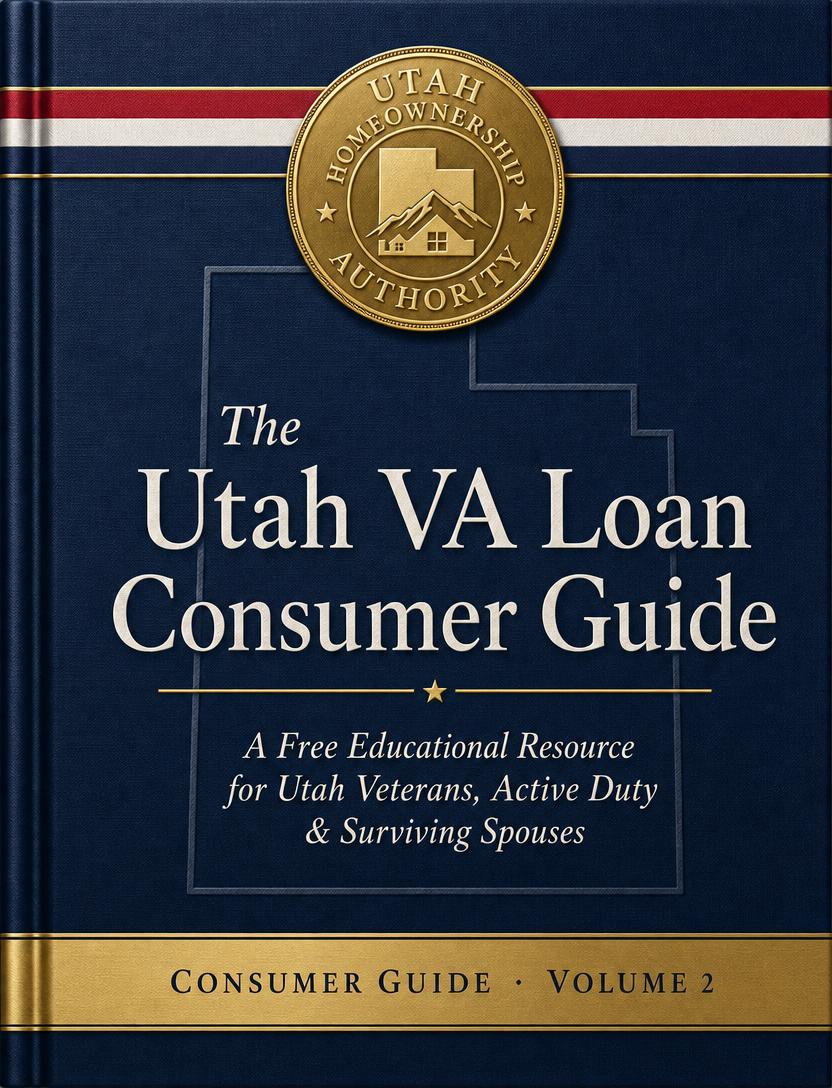
The Utah VA Loan Consumer Guide
The broad educational VA resource: loan basics, eligibility, the Certificate of Eligibility, entitlement, borrowing capacity, benefits and responsibilities, myths and FAQs, VA compared with FHA and Conventional, first-home and PCS relocation scenarios, IRRRL and VA cash-out refinancing, assumptions, repeat entitlement use, a glossary, and how to prepare for a consultation.
New to the VA benefit? Start with the Starter Kit
The VA Loan Starter Kit is the concise entry point for eligible veterans, active-duty service members, and certain surviving spouses: low- or no-down-payment options, no monthly mortgage insurance, and how the benefit may be reused. When you want the complete picture, continue to the Utah VA Loan Consumer Guide.
The Utah VA loan pathway, start to finish
1. Determine military-service eligibility
Eligibility is based on service history. Veterans, active-duty service members, many National Guard and Reserve members, and certain surviving spouses may qualify. Service requirements are set by VA, not by the lender.
2. Obtain the Certificate of Eligibility
The COE is the VA document confirming eligibility and showing entitlement and funding-fee status. Most lenders can request it electronically; you can also request it yourself through VA.gov.
3. Review entitlement
Entitlement is the portion of the loan VA guarantees. Full entitlement, reduced entitlement after a prior VA loan, and restored entitlement each affect down-payment and loan-size options.
4. Evaluate credit, income, debt, and residual income
VA does not publish a universal credit-score minimum; lenders apply their own guidelines. VA underwriting also considers residual income — money left after major monthly obligations.
5. Estimate affordability
Model the full payment: principal and interest, property taxes, homeowners insurance, and any HOA. Use the Home Affordability Calculator and the VA Loan Calculator before shopping.
6. Calculate cash to close
Zero required down payment is not the same as zero cash. The Utah VA Buyer Cash-to-Close Worksheet organizes funding fee, closing costs, prepaid items, earnest money, and credits.
7. Compare VA with FHA and Conventional
Compare monthly payment, mortgage insurance, cash required, and long-term cost — not just the interest rate. For most eligible veterans buying a primary residence, VA is competitive; the comparison still matters.
8. Obtain preapproval
A full preapproval reviews income, assets, credit, and eligibility documents. In Utah's market, a documented preapproval strengthens an offer materially.
9. Find an eligible property
VA financing is for a primary residence you intend to occupy. Single-family homes, many condos in VA-approved projects, and small multi-unit properties where you occupy a unit may be eligible.
10. Make an offer
Negotiate price, timelines, and any seller concessions. Seller-paid closing costs and concessions may reduce your cash to close, subject to VA and program limits and to what the seller agrees to.
11. Complete the VA appraisal
A VA-assigned appraiser establishes a reasonable value and reviews the property against VA Minimum Property Requirements for safety, soundness, and sanitation.
12. Complete underwriting
Underwriting verifies income, assets, credit, the appraisal, title, and eligibility. Conditions are normal; respond quickly and avoid new debt or job changes.
13. Review final cash to close
Your Closing Disclosure shows the final figures. Compare it to your worksheet and your Loan Estimate, and ask about anything that changed.
14. Close and occupy the home
VA loans carry an occupancy requirement — generally you intend to occupy the home as your primary residence within a reasonable time after closing.
15. Preserve and potentially reuse the benefit
The VA benefit is not one-time. Entitlement may be restored after a payoff or sale, and remaining entitlement may support a later purchase, subject to VA rules.
Zero down is not zero cash to close
Eligible VA buyers may not need a down payment, but a purchase still involves earnest money, closing costs, prepaid property taxes and homeowners insurance, and the VA funding fee unless it is financed or you are exempt. Seller concessions and lender credits can reduce the total. Actual figures depend on the transaction, funding-fee status, credits, underwriting, and the final closing statement.
VA loan topics, explained
What a VA loan is
A mortgage made by a private lender and partially guaranteed by the U.S. Department of Veterans Affairs. The guaranty is why lenders can offer no required down payment within entitlement and no monthly mortgage insurance.
Who may qualify
Veterans, active-duty service members, many National Guard and Reserve members with qualifying service, and certain surviving spouses. Eligibility is confirmed by the COE, not by assumption.
Certificate of Eligibility
The COE confirms eligibility and shows entitlement and funding-fee status. It does not by itself approve a loan — income, credit, assets, and the property still have to qualify.
Entitlement and restoration
Entitlement is what VA guarantees on your behalf. It can be partially used, restored after a prior VA loan is paid off, or used in part for a second VA loan in certain circumstances.
Zero-down financing
Eligible borrowers with full entitlement may purchase a primary residence with no required down payment, subject to the appraised value, underwriting, and lender approval.
The funding fee
A one-time fee paid to VA that supports the program. The percentage varies by down payment, first or subsequent use, and service category, and can generally be financed into the loan. Current percentages are published by VA.
Funding-fee exemptions
Some borrowers are exempt — for example, veterans receiving VA compensation for a service-connected disability and certain surviving spouses. Exemption status is reflected on the COE and must be verified.
Cash to close
Even with no required down payment, a VA purchase can involve earnest money, closing costs, prepaid taxes and insurance, and the funding fee if it is not financed. Model it with the cash-to-close worksheet.
Seller concessions and credits
Sellers may agree to pay allowable buyer closing costs, and separately may provide concessions within VA limits. Lender credits can also reduce cash to close. None of this is guaranteed — it is negotiated.
No monthly mortgage insurance
VA loans do not carry monthly private mortgage insurance. That is a payment advantage over FHA's monthly MIP and over conventional PMI at lower down payments.
Residual income
VA underwriting looks at income remaining after major monthly obligations, by household size and region. It is one reason some veterans qualify under VA when other programs are tighter.
Credit and underwriting
VA does not publish a universal minimum credit score; lenders set their own requirements, which vary. Payment history, debt, income stability, and residual income all factor in.
Occupancy
VA financing is intended for a home you will occupy as your primary residence. Specific timing and exceptions — including deployment and spouse occupancy — are defined by VA.
VA appraisal and minimum property requirements
A VA appraisal establishes reasonable value and confirms the property meets VA Minimum Property Requirements for safety, soundness, and sanitation. It is not a home inspection.
Assumptions
VA loans may be assumable with lender and VA approval. An assumption can transfer a favorable rate, but it can also tie up the original veteran's entitlement unless it is properly released.
Repeat use
Most eligible veterans can use the benefit more than once over a lifetime. Restoration typically follows payoff or sale, and second-tier entitlement can apply in some scenarios.
VA vs. Conventional
Conventional financing may require a down payment and, below 20% down, monthly PMI. VA generally requires no down payment within entitlement and no PMI, but does include the funding fee unless exempt.
VA vs. FHA
FHA generally requires a minimum down payment plus upfront and annual mortgage insurance premiums. VA generally requires no down payment within entitlement and no monthly mortgage insurance, and is limited to eligible borrowers.
First-time military buyers
There is no requirement to be a repeat buyer. Many Utah veterans and service members use the benefit for their very first home purchase.
PCS and relocation
Permanent Change of Station moves add timing pressure — orders, temporary housing, and appraisal and closing schedules. Northern Utah in particular sees heavy Hill Air Force Base relocation activity.
IRRRL
The Interest Rate Reduction Refinance Loan is VA's streamline refinance for an existing VA loan, typically with reduced documentation. Eligibility rules and benefit tests apply.
VA cash-out refinance
A VA cash-out refinance can replace an existing loan and access equity, subject to VA limits, appraisal, and underwriting. It is a different transaction from an IRRRL.
VA vs. FHA vs. Conventional
General program structure only. Individual results depend on eligibility, credit, the property, and lender guidelines.
| Feature | VA | FHA | Conventional |
|---|---|---|---|
| Who can use it | Eligible veterans, service members, and certain surviving spouses | Open to qualified buyers | Open to qualified buyers |
| Down payment | None required within entitlement | Minimum down payment required | Varies; commonly 3%–20% |
| Monthly mortgage insurance | None | Annual MIP, usually monthly | PMI generally required under 20% down |
| Upfront fee | VA funding fee unless exempt; may be financed | Upfront MIP; may be financed | None standard |
| Occupancy | Primary residence | Primary residence | Primary, second home, or investment |
| Reusable benefit | Yes, subject to entitlement rules | Program is reusable | Program is reusable |
VA planning worksheets
Free, printable, and educational.
Utah VA Buyer Cash-to-Close Worksheet
Estimate the cash you may actually need at closing on a Utah VA purchase — even with zero down.
Utah Home Affordability Worksheet
Map your income, debts, and reserves to a comfortable Utah home price.
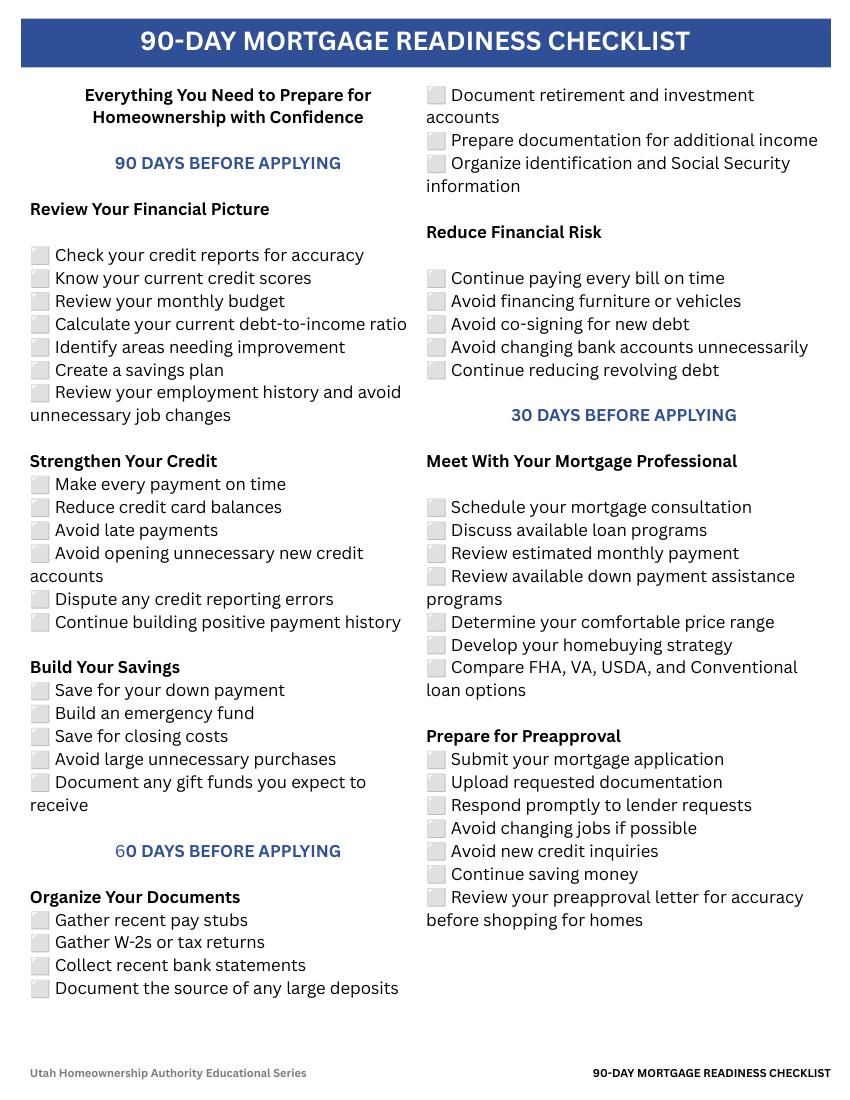
The 90-Day Utah Mortgage Readiness Checklist
A month-by-month plan to get credit, cash, and documents mortgage-ready before you write an offer in Utah.
Run your numbers
Model a VA payment, the funding fee, and cash to close.
Income, debts, and program comparison including VA.
Principal, interest, taxes, insurance, and HOA.
The full purchase process from first thought to keys.
For veterans buying their first home.
Credit factors that affect mortgage qualification.
VA deep-dive articles
The mechanics of the guaranty and the purchase process.
Service categories and how to obtain your Certificate of Eligibility.
Full, reduced, restored, and second-tier entitlement.
How the fee works, financing it, and exemptions.
Reasonable value and Minimum Property Requirements.
VA's streamline refinance for an existing VA loan.
Higher-balance VA financing in Utah's expensive markets.
The Knowledge Center deep dive on zero-down VA purchases.
How one Utah veteran used the benefit.
Beyond the mortgage: Veterans Hall
Housing is one benefit among many. Utah Veteran Resources is the broader destination for healthcare, disability, employment, education, and mental-health resources available to Utah veterans and their families.
VA videos by topic
Every video below is in the Video Library with a thumbnail, description, and captions available on YouTube.
Getting Started

Why the VA home loan benefit — no required down payment within entitlement and no monthly mortgage insurance — is one of the strongest financing options available to eligible Utah veterans.

Why the VA benefit is a lifetime earned asset rather than a one-time transaction, and how Utah veterans use it across a career and after service.

A walkthrough of the VA home loan benefits available to eligible Utah veterans, service members, and certain surviving spouses.

A focused summary of the core VA loan benefits — no required down payment within entitlement, no monthly mortgage insurance, competitive pricing, and reusable eligibility.
Eligibility, Entitlement, and Repeat Use

Zero Down and Cash to Close

How eligible Utah veterans may purchase a primary residence with no required down payment — and why zero down does not mean zero cash to close.
What a VA buyer may still need at closing even with no required down payment — funding fee, closing costs, prepaid items, earnest money, and how credits can reduce the total.

How the VA funding fee generally works, when an exemption may apply, and how the fee can be financed into the loan or paid at closing.
Myths and Misinformation

Loan Strategy and Comparisons

A side-by-side look at VA and conventional financing — down payment, mortgage insurance, qualification considerations, and long-term cost.

A step-by-step walkthrough for first-time military and veteran buyers using the VA benefit in Utah.

VA loan questions Utah veterans ask
Can I buy a home in Utah with no down payment using a VA loan?
Eligible borrowers with full entitlement may be able to purchase a primary residence with no required down payment, subject to the appraised value, underwriting, and lender approval. It is an eligibility-based benefit, not an automatic approval.
Does zero down mean zero cash needed at closing?
No. A VA purchase can still involve earnest money, closing costs, prepaid property taxes and insurance, and the funding fee if it is not financed. Seller concessions and lender credits may reduce the amount. The Utah VA Buyer Cash-to-Close Worksheet organizes those figures.
How do I obtain my Certificate of Eligibility?
Most lenders can request the COE electronically on your behalf. You can also request it yourself through VA.gov or by submitting the VA's eligibility form. Supporting service documentation may be requested depending on your service category.
What is VA entitlement?
Entitlement is the amount VA guarantees to the lender on your behalf. Full entitlement generally supports no-down-payment financing; reduced entitlement after a prior VA loan can change down-payment and loan-size options.
Can I use my VA benefit more than once?
Often, yes. Entitlement can typically be restored after a prior VA loan is paid off, and remaining entitlement may support another VA loan in certain circumstances, subject to VA rules and lender approval.
What is the VA funding fee?
A one-time fee paid to VA that helps sustain the program. The percentage depends on down payment, whether it is a first or subsequent use, and service category, and it can generally be financed into the loan. Current percentages are published by VA.
Who may be exempt from the funding fee?
Exemptions apply to defined categories — for example, veterans receiving VA compensation for a service-connected disability and certain surviving spouses. Exemption status appears on the COE and must be verified.
Does a VA loan require monthly mortgage insurance?
No. VA loans do not carry monthly private mortgage insurance. That is one of the program's largest monthly-payment advantages.
Can a VA loan be assumed?
VA loans may be assumable with lender and VA approval. The original veteran's entitlement can remain tied to the loan unless it is properly released, so review that carefully before agreeing to an assumption.
Can I buy a condominium with a VA loan?
Condominiums may be eligible when the project meets VA requirements. Project approval status matters, so confirm it before writing an offer on a condo.
Can I use a VA loan for a second home or investment property?
VA financing is intended for a primary residence you will occupy. Some multi-unit properties may be eligible when you occupy one of the units, subject to VA rules and underwriting.
What is the VA appraisal?
A VA-assigned appraiser establishes a reasonable value for the property and reviews it against VA Minimum Property Requirements for safety, soundness, and sanitation. It is not a substitute for a home inspection.
What credit score do I need for a VA loan?
VA does not publish a universal minimum credit score. Individual lenders set their own requirements, and they vary. Credit history, debt, income stability, and residual income are all reviewed together.
Can a first-time buyer use a VA loan?
Yes. There is no requirement to have owned a home before. Many eligible Utah veterans and service members use the benefit for their first purchase.
Is Utah Homeownership Authority part of the VA?
No. Utah Homeownership Authority is a private educational and mortgage resource. It is not a government agency and is not affiliated with, endorsed by, or acting on behalf of the U.S. Department of Veterans Affairs. Official program information is published by VA at va.gov.
Thinking about using your VA benefit?
Bring your questions and, if you have it, your COE. Tres will walk through eligibility, payment, and cash to close — educational, no obligation.