
Are you ready to apply — and if not, what should you fix first?
How credit is actually reviewed, what may be preventing qualification, what to improve first, which program resources apply, and when to move from education to prequalification or preapproval.
Mortgage readiness is the combination of credit, documented income and employment, debts, available and documented funds, and the property — not a credit score by itself. Start by reviewing your full credit reports for accuracy, calculating your debt-to-income, identifying and documenting your funds, and assembling your paperwork. Then compare loan programs and move to prequalification or preapproval. Nothing on this page is an eligibility determination, a loan approval, or a commitment to lend.
Start here
Seven steps, in order. Each one answers a different question.
A short self-assessment of credit, documentation, funds, and timing before you apply.
Work through your reports line by line for accuracy before deciding what to improve.
Compare monthly obligations to gross monthly income and see where the ratio lands.
The full sequence from preparation through preapproval, so nothing happens out of order.
Credit cleanup, documentation, and funds organized into 30, 60, and 90 day blocks.
Income, employment, assets, and identification — collected before a lender asks.
Bring your worksheets and questions. Educational, no obligation.

The Utah Credit Improvement Consumer Guide
A plain-English guide to understanding credit scores, correcting common credit problems, lowering balances, building stronger financial habits, and preparing for better mortgage opportunities.
The Utah mortgage readiness pathway
1. Decide what you are preparing for
Purchase, refinance, or a longer-term plan. Readiness work is the same in kind but different in urgency depending on your timeline.
2. Pull your credit reports
Review the reports themselves, not just a score from an app. Consumers may request free reports through the federally authorized site, AnnualCreditReport.com.
3. Review the reports for accuracy
Confirm accounts, balances, limits, payment history, and personal information are correct. Inaccurate information can be disputed with the credit bureau and the furnisher.
4. Understand what the score reflects
Payment history, amounts owed and utilization, length of credit history, credit mix, and new credit. Scoring models differ, and the score a lender pulls may not match a consumer app.
5. Identify what is holding the file back
Late payments, high revolving balances, collections, limited history, or recent credit events each call for a different response. Fix the cause, not the symptom.
6. Stop adding new risk
New accounts, large financed purchases, and unnecessary inquiries close to an application can change the picture. Job and income changes matter too.
7. Calculate your debt-to-income
Compare monthly obligations reported on credit against gross monthly income. DTI is one of the most common reasons an otherwise strong file needs restructuring.
8. Decide what to pay down first
Reducing revolving utilization and eliminating a small payment that carries a large monthly obligation often move the needle differently. Compare both before paying.
9. Estimate a comfortable payment
Model principal, interest, property taxes, homeowners insurance, mortgage insurance if applicable, and any HOA — not principal and interest alone.
10. Identify and document funds
Down payment, closing costs, prepaid items, and reserves. Where the money came from matters as much as how much there is.
11. Gather documentation
Income, employment, assets, and identification. Self-employed, commission, bonus, and variable income are documented differently than salaried W-2 income.
12. Review which programs may fit
Conventional, FHA, VA if eligible, USDA where applicable, and any down-payment assistance. Program fit changes what readiness actually requires.
13. Re-run the readiness assessment
After 30, 60, or 90 days of work, review again. Changes must report to the bureaus before they can be reflected in a lender's pull.
14. Move to prequalification
A prequalification is an early, limited review. It is useful for direction, but it is not the same as a documented preapproval.
15. Move to preapproval
A full preapproval reviews credit, income, and assets. In Utah's market, a documented preapproval materially strengthens an offer. It is still not a final loan approval.
What may be preventing qualification
Different causes call for different responses. Fix the cause, not the symptom.
| What is happening | What to work on first | Where to start |
|---|---|---|
| Score is lower than expected | Confirm the reports are accurate before assuming the score is correct | Credit Report Review Worksheet |
| Revolving balances are high | Reduce utilization and let statements report the new balances | 90-Day Mortgage Readiness Checklist |
| Monthly debt feels heavy | Calculate debt-to-income and identify which payment removal helps most | Debt-to-Income Worksheet |
| Income is variable or self-employed | Understand how the income will be documented and averaged | Utah Self-Employed Borrower Guide |
| Unsure how much cash is needed | Separate down payment, closing costs, prepaids, and reserves | Utah Closing Cost Guide |
| Funds exist but are not documented | Source and document deposits, gifts, and transfers early | Mortgage Application Document Checklist |
| Limited credit history | Ask which alternative documentation may be considered | Schedule a readiness review |
| Not sure which program fits | Compare program structure before optimizing for one of them | Loan Programs comparison |
Credit and readiness topics, explained
What mortgage readiness means
Readiness is the combination of credit, income and employment documentation, debts, available and documented funds, and the property. A strong score alone does not make a file ready.
Score is one factor, not the decision
Approval depends on the whole file — credit, income, assets, debts, the property, program guidance, underwriting, and individual lender requirements. No score guarantees approval.
Where to get your reports
Consumers may request free credit reports through AnnualCreditReport.com, the site authorized by federal law. A consumer app score and a lender's score can differ.
Accuracy before optimization
Correcting inaccurate information is a different task from improving a legitimate weakness. Review for accuracy first, then decide what to improve.
Disputing inaccurate information
Inaccurate items may be disputed with the credit bureau and the furnisher of the information. Timelines and outcomes vary, and a dispute is not a guarantee of removal.
Payment history
The record of paying on time is generally the single largest scoring factor. Recent lates typically carry more weight than older ones.
Utilization
Revolving balances relative to limits influence scores and can change month to month as statements report. Paying a card down does not update instantly.
Length of history and credit mix
Older accounts and a reasonable mix of account types generally help. Closing an old account can shorten average history.
New credit and inquiries
Opening new accounts before or during a mortgage application can change qualification. Rate-shopping for a mortgage in a short window is treated differently than opening unrelated new credit.
Collections and charge-offs
How these are treated varies by program, by amount, and by lender. Paying one without understanding the effect is not automatically the right move.
Debt-to-income ratio
DTI compares monthly obligations to gross monthly income. Allowable ratios differ by program and depend on compensating factors, automated findings, and lender guidelines.
Student loans
Student loans are generally included in the debt calculation even when deferred or on an income-driven plan. How the monthly figure is calculated follows program guidance and lender interpretation.
Income documentation
Underwriting reviews documented, stable income. How income is calculated matters more than the headline figure, particularly for self-employed and variable-income borrowers.
Assets, funds, and reserves
Funds must be identified, sourced, and documented. Large unexplained deposits create conditions; gift funds require their own documentation.
Prequalification vs. preapproval
A prequalification is an early, limited review. A preapproval involves a fuller review of credit, income, and assets. Neither is a final loan approval or a commitment to lend.
Lender overlays
An overlay is a lender requirement stricter than program guidance. Two lenders can review the same borrower and reach different conclusions.
Credit repair claims
Be cautious with any service promising guaranteed score increases or removal of accurate information. Accurate, verifiable information generally cannot be removed on demand.
When to stop preparing and apply
When accuracy is confirmed, obligations are known, funds are documented, and further waiting would not materially change the file, the next step is a lender conversation.
Five qualification questions, explained in detail
These come up in almost every readiness conversation, and each one is commonly oversimplified. Educational information only — program guidance, automated underwriting findings, and individual lender requirements control the outcome on any specific file.
How mortgage credit scoring actually works
Mortgage lenders generally do not use the score shown in a free consumer app. They typically pull reports from the credit bureaus with mortgage-specific scoring versions, which are built and weighted differently than the educational scores consumers see day to day. The same file can produce meaningfully different numbers depending on which model is run.
When more than one borrower is on the loan, how the scores are evaluated depends on the loan program, the automated underwriting system, and the individual lender's requirements. Some programs and systems look at a representative score for the file, some evaluate borrowers individually for specific requirements, and lender overlays can add their own rules on top. There is no single universal rule that applies to every program, every borrower combination, and every lender.
The practical takeaway: treat any score you see outside a lender pull as directional, and ask your lender which scores and which program guidance apply to your specific file before making decisions based on a number.
Authorized-user accounts
An authorized-user account is a tradeline you can use but are not contractually responsible for. These accounts can appear on your credit reports and can influence scoring models, which is why some people are added to a relative's older, well-paid card.
In mortgage underwriting these accounts are reviewed in context rather than accepted at face value. Underwriting may look at whose account it is, how long it has been open, how it has been paid, and how much of the file's strength depends on it. Depending on program guidance and lender requirements, an authorized-user tradeline may be considered, may be given limited weight, or may prompt a closer review of the borrower's own credit history.
Do not add or remove authorized-user accounts right before applying without discussing it first — either direction can change the file.
Large deposits and source-of-funds documentation
Underwriting has to confirm that the money used for a down payment, closing costs, and reserves is yours and is not undisclosed borrowed money. That is why a deposit that is large relative to your normal income pattern draws a request for an explanation and supporting records.
Typical documentation includes the bank statements showing the deposit, a copy of the item deposited or a transaction record, and a short written explanation of where the funds came from. Gift funds have their own requirements, usually a signed gift letter plus evidence of the transfer, and sometimes evidence from the donor's account. Cash that cannot be sourced generally cannot be used.
The easiest version of this is preparation: consolidate funds early, avoid moving money between accounts without a paper trail, and keep records for anything unusual in the two to three months before you apply.
Conditional approval — what it is and is not
Most approvals arrive first as a conditional approval. An underwriter has reviewed the file and is willing to proceed, provided a specific list of remaining conditions is satisfied. Those conditions may involve updated documentation, an explanation letter, verification of employment, appraisal items, title items, or evidence that a debt was paid.
A conditional approval is not a final approval and is not a commitment to lend. The loan is not clear to close until the conditions are received, reviewed, and accepted, and underwriting may re-verify credit and employment before closing.
The fastest path through conditions is to return exactly what was asked for, in the format requested, without introducing new information — new accounts, job changes, or undocumented transfers during this window can create additional conditions.
Manual underwriting
Most files are run through an automated underwriting system. When a file cannot receive an automated recommendation — or when program guidance calls for it — it may be reviewed manually by an underwriter instead.
Manual underwriting is not an automatic denial, and it is not an automatic approval. It is a more detailed, judgment-based review of the whole file: payment history, the reason behind any credit event, income stability, reserves, housing payment history, and compensating factors. Program guidance and lender requirements typically apply tighter ratios and more documentation in a manual review.
Files with limited traditional credit history, a recent significant credit event, or unusual income structures are the ones most likely to see it. If it applies to you, ask early what compensating factors matter, because that determines what is worth doing in the next 30 to 90 days.
Keep going from here
Readiness work connects directly to payment math, cash to close, vocabulary, and assistance programs. Continue with the Mortgage Calculator to model principal, interest, taxes, insurance, and HOA together; review the Closing Costs Resource Center so cash to close is not a surprise late in the process; keep the Mortgage Glossary open while reading underwriting conditions; check the Down-Payment Assistance Resource Center before assuming a down payment gap is disqualifying; and if student loans are the obligation you are worried about, work through the Debt-to-Income Worksheet — deferred and income-driven student loan payments are generally still counted, and how the monthly figure is calculated follows program guidance and lender interpretation.
Readiness worksheets
Free, printable, and educational.
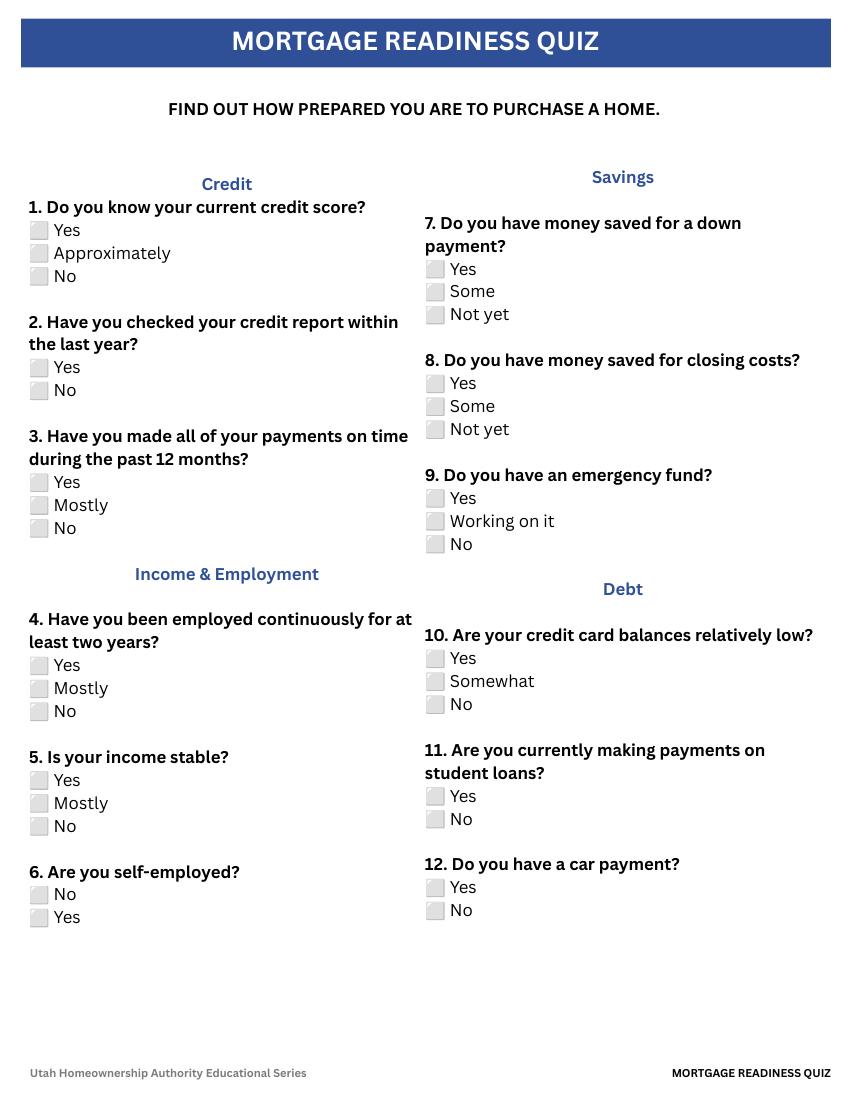
Mortgage Readiness Quiz
A short self-assessment that shows how prepared you are to buy — and what to do next.

Credit Report Review Worksheet
Review your reports line by line before a lender does.

Debt-to-Income Worksheet
Estimate your housing ratio and total debt ratio before you apply.

Mortgage Qualification Pathway
The ten stages from 'thinking about it' to a documented preapproval — and the resource that helps at each one.

Mortgage Application Document Checklist
Gather the documentation underwriting is likely to request.
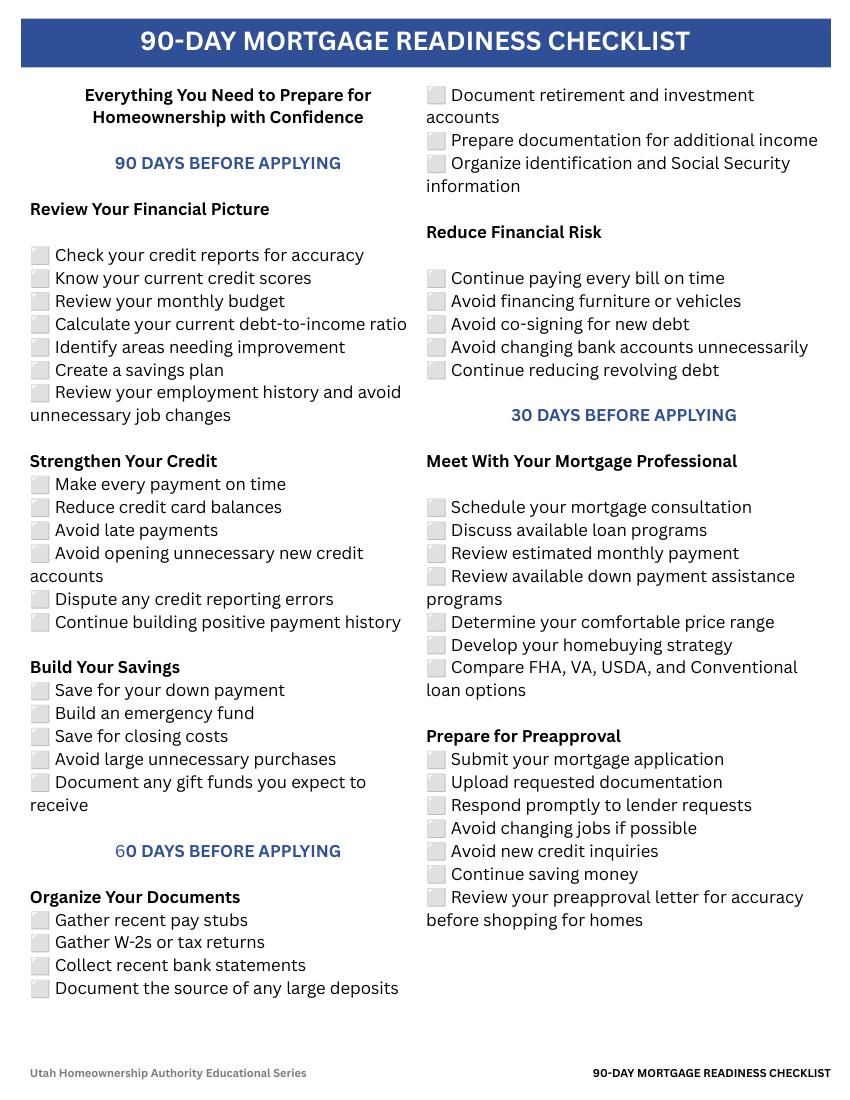
The 90-Day Utah Mortgage Readiness Checklist
A month-by-month plan to get credit, cash, and documents mortgage-ready before you write an offer in Utah.

Utah Home Affordability Worksheet
Map your income, debts, and reserves to a comfortable Utah home price.
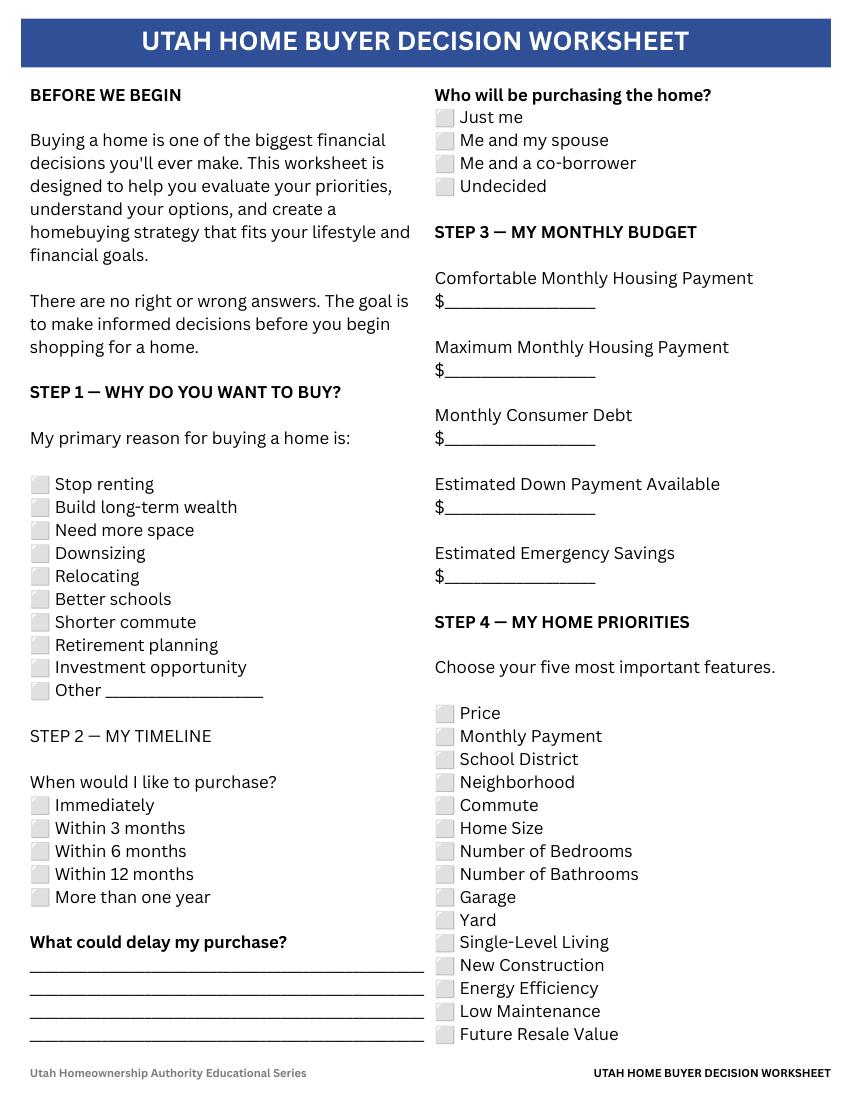
Utah Home Buyer Decision Worksheet
Evaluate your priorities, compare your options, and build a home-buying strategy before you start shopping.

The Utah First-Time Buyer Savings Planner
Turn a down payment goal into a monthly savings number you can actually hit.
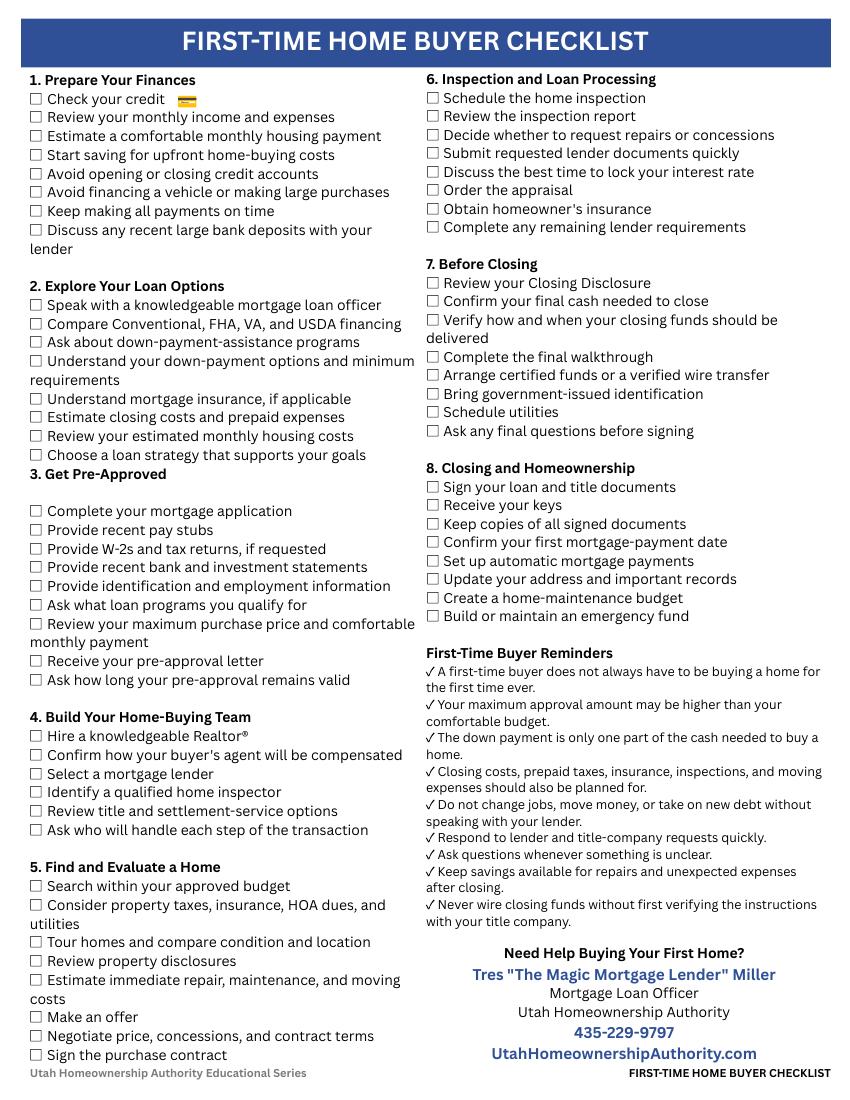
Utah First-Time Home Buyer Checklist
Every task from financial preparation through closing and your first months of homeownership.
Which loan program resources apply to you
Readiness looks different depending on the program you end up using.
More flexible qualification and a lower minimum down payment for eligible buyers.
No required down payment within entitlement and no monthly mortgage insurance for eligible borrowers.
Often lower long-term cost for stronger credit and more equity.
A zero-down option for eligible rural Utah properties and incomes.
Utah programs that may layer with several loan types.
The full first-time buyer path in Utah, start to finish.
How business income is documented and averaged in underwriting.
What program guidance and lender overlays each contribute.
Side-by-side structure so the choice is based on total cost, not just the rate.
Readiness videos by topic
Every video below is in the Video Library with a thumbnail, description, and captions available on YouTube.
Readiness and timing

A practical 90-day view of mortgage preparation — reviewing credit reports for accuracy, letting changes report, gathering documentation, and organizing funds before a lender reviews the file. Educational only; it is not an approval or a guarantee of qualification.

How a first-time Utah purchase sequences from early preparation through preapproval, home search, underwriting, and closing, and where readiness work belongs in that timeline.

Factors homebuyers may consider when deciding whether to purchase a home now or wait — personal finances, housing needs, market conditions, and long-term goals.
Credit

What credit scores lenders look at and how to improve yours.

How credit scores can affect mortgage qualification, and why minimum credit requirements can vary by loan program, lender guidelines, and individual borrower circumstances.

How credit is evaluated on an FHA file — why FHA program guidance and individual lender requirements are not always identical, and why a credit score alone does not determine approval.
Debt and income

How DTI is calculated and why it matters for approval.

How debt-to-income ratio is calculated and why lenders use it as one factor when evaluating a borrower's ability to qualify for a mortgage.

The key factors that influence home affordability — income, debts, available cash, and the monthly payment a buyer is comfortable managing.
Cash to close

The types of cash a homebuyer may need when purchasing a home — down payment, closing costs, prepaid expenses, and other transaction-related costs.

How gift funds work for a Utah down payment.

How down payment assistance programs generally work, who may qualify, and why program requirements, funding availability, and repayment terms can vary.

How seller-paid closing costs — sometimes called seller concessions — may help cover eligible buyer closing expenses, subject to loan-program and transaction limits.

Every closing cost line item, decoded.
Mistakes to avoid

Financial and credit changes that may affect a mortgage application before closing — new debt, employment changes, large purchases, and unexplained financial activity.

The same mistakes buyers keep making — and easy fixes.

Five common mistakes homebuyers make during the mortgage and home-buying process, and how better preparation helps buyers make more informed decisions.

Tres Miller busts three of the most common mortgage myths Utah homebuyers still believe — and shows what the truth means for your down payment, credit, and offer.
Program readiness

A short overview of FHA financing — a mortgage insured by the Federal Housing Administration and issued by an approved private lender, which may offer a lower down payment and more flexible qualification standards for eligible buyers of a primary residence.

A focused summary of the core VA loan benefits — no required down payment within entitlement, no monthly mortgage insurance, competitive pricing, and reusable eligibility.

Key differences between FHA and conventional mortgage financing — general qualification considerations, down payment options, mortgage insurance, and borrower profiles.

How USDA financing works for rural Utah homebuyers.
Credit and readiness questions Utah buyers ask
What credit score do I need to buy a home in Utah?
There is no single number. Each loan program publishes its own guidance and individual lenders apply their own requirements on top of it. Score is reviewed alongside payment history, debt-to-income, income stability, assets, reserves, and recent credit events. Meeting a score threshold does not by itself produce an approval.
Where can I get my credit reports for free?
Consumers may request free credit reports through AnnualCreditReport.com, the site authorized by federal law. Reviewing the full reports is more useful than reviewing only a score from a consumer app, because the reports show the underlying accounts and history a lender reviews.
Why is my lender's score different from my credit app score?
Different scoring models and different data sources produce different numbers. Mortgage lenders typically use specific scoring versions that may not match the score shown in a free consumer app. Neither number is wrong; they are measuring with different rules.
How long does it take to improve mortgage readiness?
It depends entirely on what is holding the file back. Correcting inaccurate information, letting balances report lower, and organizing documentation can happen in a matter of weeks or months. Rebuilding after a significant credit event generally takes longer. A 30, 60, and 90 day plan is a useful structure, not a guaranteed schedule.
Should I pay off collections before applying?
Not automatically. How collections are treated varies by program, by balance, and by lender, and paying one can occasionally change how it reports. Review the specific accounts with a lender before paying, so the payment actually helps the file.
Should I close old credit cards before applying?
Generally no. Closing an older account can shorten your average length of credit history and reduce total available credit, which can raise utilization. Review before closing anything.
What is debt-to-income and why does it matter?
Debt-to-income compares your monthly obligations to your gross monthly income. It is a central underwriting factor and one of the most common reasons an otherwise strong file needs restructuring. Allowable ratios vary by program and depend on compensating factors and lender guidelines.
Are student loans counted if they are deferred?
Generally yes. Student loans are typically included in the debt calculation even when payments are deferred or on an income-driven plan. How the monthly figure is calculated follows program guidance and lender interpretation, so ask before assuming a deferred loan is excluded.
Does checking my own credit hurt my score?
Reviewing your own reports is a soft inquiry and is not treated the same as a lender's hard inquiry. Rate-shopping for a mortgage within a short window is also generally treated differently than opening unrelated new credit accounts.
What should I avoid doing before closing?
Avoid opening new credit, financing large purchases, moving money between accounts without documentation, and changing jobs or income structure. Underwriting can re-verify credit and employment before closing.
What is the difference between prequalification and preapproval?
A prequalification is an early, limited review that gives direction. A preapproval involves a fuller review of credit, income, and assets. Neither is a final loan approval or a commitment to lend, and both can change if your file changes.
Can I get a mortgage with limited credit history?
It may be possible. Some programs allow alternative documentation of payment history such as rent, utilities, or insurance, subject to program guidance and lender requirements. Ask early, because it changes what documentation you should be collecting now.
Do credit repair companies work?
Be cautious with any service that promises a guaranteed score increase or the removal of accurate information. Accurate, verifiable information generally cannot be removed on demand, and you can dispute inaccurate information yourself at no cost.
How much cash do I actually need?
Cash to close typically includes the down payment, closing costs, prepaid property taxes and homeowners insurance, and any program-specific upfront fees — less earnest money already paid and any seller or lender credits. Down-payment assistance and gift funds may be options for eligible buyers.
Which readiness resource should I start with?
Start with the Mortgage Readiness Quiz, then the Credit Report Review Worksheet and the Debt-to-Income Worksheet. Use the Mortgage Qualification Pathway to see the sequence, the 90-Day Mortgage Readiness Checklist to work the plan, and the Mortgage Application Document Checklist to assemble paperwork.
When should I stop preparing and talk to a lender?
When your reports are accurate, your obligations are known, your funds are identified and documented, and further waiting would not materially change the file. A lender review is educational and carries no obligation.
Is Utah Homeownership Authority a credit repair or government agency?
No. Utah Homeownership Authority is a private educational and mortgage resource. It is not a credit repair organization, not a government agency, and not affiliated with or endorsed by any government agency. Everything on this page is educational information only.
Not sure whether you are ready to apply?
Bring your worksheets and your questions. Tres will walk through what underwriting reviews, what may be holding the file back, and what would change the picture — educational, no obligation.